
Losing a tooth changes more than your smile. It changes how you eat, how you speak, and sometimes how you carry yourself walking into a room. If you’ve been putting off a conversation about tooth replacement, you’re not alone — plenty of patients in Madison Heights and Troy wait longer than they should, usually because they’re not sure whether implants are even the right fit for them.
Here are five signs that tooth replacement deserves a closer look, what your options actually are, and how to take the next step when you’re ready.
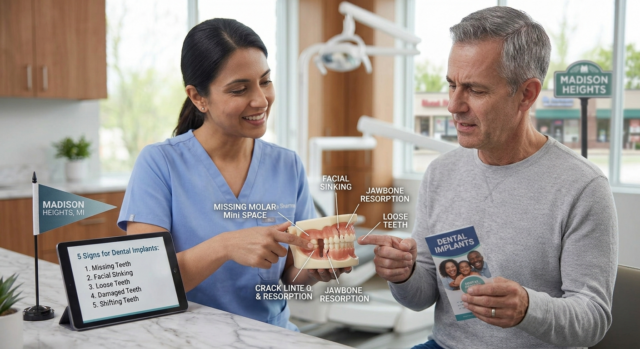
Sign 1: You Have One or More Missing Teeth
It sounds obvious, but it’s worth saying plainly: a gap in your smile is the clearest signal that something needs to be done.
When a tooth goes missing, the bone beneath it starts to shrink. Without a root to stimulate it, that bone gradually resorbs — and over time, that affects neighboring teeth, changes the shape of your jaw, and narrows your treatment options. The earlier you address it, the more choices you have.
Dental implants replace both the root and the visible tooth, which helps preserve bone and keeps the surrounding teeth where they belong.
Sign 2: You Have a Cracked or Broken Tooth That Can’t Be Saved
Not every damaged tooth can be rescued with a filling or a crown. When a crack runs below the gum line or a tooth has fractured at the root, extraction is often the most practical path forward.
If you’ve recently been told a tooth needs to come out, that’s the right moment to ask about replacement in the same conversation. Planning ahead means less time with a gap and a clearer sense of what recovery actually looks like.
Sign 3: You’re Wearing Dentures That Don’t Fit Well Anymore
Ill-fitting dentures are one of the most common reasons patients in Madison Heights and Troy start looking into implants. Dentures that slip, click, or cause sore spots aren’t just uncomfortable — they make eating and speaking feel unpredictable. Many patients quietly stop eating the foods they enjoy most and never quite connect that shift to their dental situation.
Two implant-based options address this directly:
- Mini dental implants are a less invasive option that can stabilize a lower denture without the bone volume required for standard implants. In many cases, they’re placed in a single visit with less recovery time.
- All-on-X full arch implants (a fixed set of replacement teeth anchored to four or more implants) replace an entire arch permanently. They look and feel like natural teeth, and you don’t take them out at night.
If you’ve been living with dentures that feel unreliable, both options are worth a direct conversation with a dentist who places them.
Sign 4: You’re Avoiding Certain Foods Because of a Missing or Damaged Tooth
Pay attention to what you’ve quietly stopped eating. Hard fruits, chewy proteins, crusty bread. If your diet has shifted around a dental problem rather than through it, that’s a meaningful sign.
Implants restore full biting function for most patients. Unlike a removable denture, an implant is anchored in the bone — it doesn’t shift when you bite down. Patients often describe eating with implants as feeling natural in a way that dentures simply can’t replicate.
Sign 5: You Feel Self-Conscious About Your Smile
If you find yourself covering your mouth when you laugh, angling away from photos, or hesitating before you speak because of a gap or damaged tooth, that’s a quality-of-life issue — not a vanity one.
Implants are designed to blend with your natural teeth. The visible crown is matched to the color and shape of what’s already there, so the result looks like it was always part of your smile. For patients missing several teeth or an entire arch, All-on-X can restore a full, natural-looking result in a way that removable options often can’t match.
Which Type of Implant Is Right for You?
There’s no single answer, and that’s actually good news. Different patients have different needs, and having more than one option means more people can qualify for treatment.
| Option | Best for | Key feature |
|---|---|---|
| Standard dental implant | Single tooth replacement with adequate bone | Long-term, fixed solution |
| Mini dental implant | Lower bone density or denture stabilization | Less invasive placement |
| Ultra-short implant | Limited bone height without grafting | Avoids bone graft in some cases |
| All-on-X full arch | Full arch replacement | Fixed, permanent, no removal |
| Implant-supported denture | Multiple missing teeth | Combines stability with removability |
At Arch Dental in Madison Heights, the team places mini dental implants, standard implants, ultra-short implants, and All-on-X full arch implants. That range matters. It means your treatment plan is shaped by what works for your mouth — not by what a practice happens to offer.
What About Dental Anxiety?
If the idea of implant surgery makes you want to close this tab, you’re in good company. Many patients who come to Arch Dental have been putting off treatment for years because of anxiety around dental procedures.
Painless dentistry isn’t a tagline here — it’s the standard approach. The practice has a dedicated page for nervous patients at archdental.net/nervous-patient because this is a real part of how care is delivered, not an afterthought added to the website.
What to Do Next in Madison Heights
If any of the five signs above sound familiar, the next step is a consultation — not a commitment. A consultation gives you a clear picture of your bone health, your options, and what a realistic treatment timeline looks like for your specific situation.
Arch Dental serves patients in Madison Heights, Troy, Oak Park, Hazel Park, and Royal Oak. You can book directly at archdental.net/book-an-appointment or learn more at archdental.net.
Frequently Asked Questions
Are dental implants painful to get?
Most patients find the procedure more comfortable than they expected. Local anesthesia is used during placement, and managing your comfort throughout is a priority at Arch Dental. Some soreness afterward is normal and typically manageable with over-the-counter medication.
How long do dental implants last?
With proper care, the implant itself — the titanium post in the bone — is designed to last many years. The crown on top may eventually need replacement depending on wear, but the foundation is built to be long-term.
What if I don’t have enough bone for implants?
This is one of the most common concerns patients bring in, and it doesn’t automatically rule out implants. Mini dental implants and ultra-short implants are specifically designed for patients with lower bone density or limited bone height. A consultation with imaging will show which options apply to your situation.
Can implants replace a full arch of missing teeth?
Yes. All-on-X full arch implants are designed exactly for this — a full set of fixed replacement teeth anchored to four or more implants. You don’t remove them, and they function like natural teeth.
What’s the difference between mini dental implants and standard implants?
Mini dental implants are a less invasive option. They’re narrower and often placed without the bone preparation that standard implants require, which means shorter treatment time and less recovery for many patients. They work well for denture stabilization and for patients who aren’t candidates for traditional implant placement.
How do I know if I’m a candidate?
The main factors are bone volume, overall oral health, and general health. The best way to find out is through a consultation that includes imaging. Many patients who assume they don’t qualify are surprised to learn that one of the available implant types is a good fit for them.
Does Arch Dental serve patients outside of Madison Heights?
Yes. The practice serves patients in Madison Heights, Troy, Oak Park, Hazel Park, and Royal Oak, with emergency dental care available across all five areas.
You don’t have to keep working around a missing tooth or a denture that doesn’t fit. If any of these signs feel familiar, a conversation with the team at Arch Dental is the right next step. Book your consultation at archdental.net.
