
If you’re missing one or more teeth, you’ve likely already heard the two most common solutions: dental implants and dentures. Both replace missing teeth. Both help you eat and speak more comfortably. But they work differently, last differently, and feel very different in your mouth over time.
So which one is actually worth your money in 2026? The honest answer depends on your bone health, your budget, how many teeth you’re replacing, and what you want your daily life to look like. Here’s a clear breakdown of the real differences so you can walk into your dentist’s office with better questions.
What Are Dental Implants?
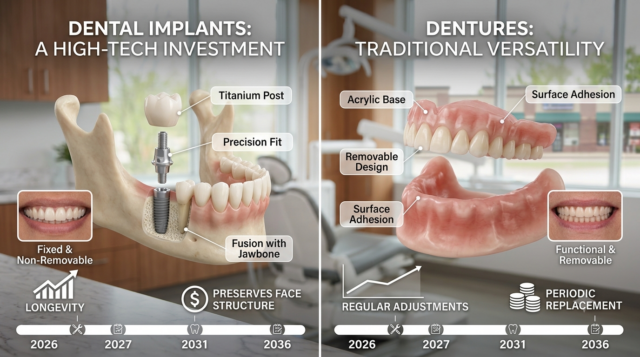
A dental implant is a small titanium post placed into your jawbone to act as an artificial tooth root. Once it bonds with the bone over a few months, a crown, bridge, or full arch of teeth is attached on top.
The result is a replacement tooth anchored directly in your jaw. It doesn’t shift, doesn’t need adhesive, and stimulates the bone the same way a natural root does.
Patients in Madison Heights and Troy have access to several implant types at a single practice like Arch Dental:
- Standard implants for single or multiple tooth replacement
- Mini dental implants, a less invasive option using a narrower post that can work well for patients who’ve experienced bone loss or aren’t candidates for bone grafting
- Ultra-short implants for cases where bone height is limited
- All-on-X full arch implants, a fixed set of replacement teeth for an entire upper or lower arch, supported by just four to six strategically placed implants
All-on-X tends to confuse people, so it’s worth clarifying: it simply means all the teeth on one arch are supported by a small number of implants. You leave with a full set of fixed teeth — not a removable plate.
What Are Dentures?
Dentures are removable appliances that sit on top of your gums. Complete dentures replace all teeth on an arch; partial dentures fill in gaps when some natural teeth remain.
Modern dentures fit better than older versions and can look quite natural. But they still rely on suction, your gum ridge, or dental adhesive to stay in place. Over time, as the jawbone naturally shrinks following tooth loss, the fit changes — and dentures may need relining or replacing.
Your options include:
- Complete dentures for a full arch of missing teeth
- Partial dentures when some natural teeth remain
- Implant-supported dentures, which snap onto implants for better stability while remaining removable
- Overdentures, which fit over remaining teeth or implants
The Core Differences: A Side-by-Side Look
| Factor | Dental Implants | Dentures |
|---|---|---|
| Stability | Fixed in the jaw, no movement | Removable; can shift or slip |
| Bone preservation | Yes, stimulates the jawbone | No; bone loss continues over time |
| Maintenance | Brush and floss like natural teeth | Daily removal and cleaning required |
| Durability | Can last decades with good care | Typically need replacement every 5–10 years |
| Candidacy | Requires adequate bone or grafting | Available to almost anyone |
| Procedure | Surgical, multiple appointments | Non-surgical, faster to fit |
| Feel | Most similar to natural teeth | Takes adjustment; some report discomfort |
Short-Term Cost vs. Long-Term Value
This is where most people get tripped up. Dentures typically cost less upfront than implants — but that comparison doesn’t account for what happens over the next 10 to 20 years.
With dentures, you’ll likely need relining as your jaw changes shape, and full replacement at some point down the road. Cleaning products and adhesives add up too. And because dentures don’t stop bone loss, some patients eventually reach a point where even a well-made denture no longer fits properly.
Implants cost more upfront. But a well-placed implant can last many years without replacement, and it actively preserves the bone underneath. Over a 20-year window, the total cost picture often looks quite different from what the initial price comparison suggests.
Mini dental implants deserve a specific mention here. They’re a less invasive option than standard implants, often requiring less bone volume and a shorter procedure. For patients who’ve been told they aren’t candidates for traditional implants due to bone loss, mini implants may open a door that seemed closed.
Who Is a Better Candidate for Implants?
You’re likely a strong implant candidate if:
- You’re missing one or a few teeth and have healthy bone
- You want a permanent, fixed solution that feels natural
- You’re comfortable with a multi-step process over several months
- You’re in good general health with no uncontrolled conditions affecting healing
Dentures or implant-supported dentures may be worth exploring if:
- You’ve experienced significant bone loss and aren’t ready for grafting
- You need a faster solution
- You’re replacing a full arch and want to weigh your options before committing to full arch implants
These aren’t always either/or decisions. Implant-supported dentures and overdentures combine both approaches — the stability of implants with the accessibility of a removable appliance.
What About Dental Anxiety?
Many patients in Madison Heights and Troy put off tooth replacement decisions simply because they’re nervous about dental procedures. That’s completely understandable. It’s worth saying directly: implant placement does involve a surgical step, but modern techniques and proper numbing make the experience far more comfortable than most patients expect.
At Arch Dental, painless dentistry isn’t a tagline — it’s the standard approach across all procedures, including implant placements. If anxiety has kept you from exploring your options, that’s worth bringing up before you make any decisions. You can learn more at archdental.net/nervous-patient.
Making the Decision in Madison Heights or Troy
The right choice between implants and dentures comes down to your jaw structure, health history, how many teeth you’re replacing, and what daily comfort means to you. There’s no universal answer, and any dentist who offers one without examining you first isn’t giving you the full picture.
What you can do right now is schedule a consultation at Arch Dental in Madison Heights. The practice offers the full range — standard implants, mini dental implants, All-on-X full arch implants, complete and partial dentures, and implant-supported dentures — all under one roof. Having every option available means your recommendation is based on your actual clinical picture, not on whatever a practice happens to offer.
Frequently Asked Questions
Are dental implants more painful than getting dentures?
The implant process involves a surgical step, but most patients report less discomfort than they anticipated. Local anesthesia is used throughout, and practices focused on patient comfort manage the experience carefully. Dentures involve no surgery but can cause soreness as your gums adjust to a new appliance.
How long do dental implants last compared to dentures?
Implants can last many years or even decades with proper care. Dentures typically need relining or replacement every 5 to 10 years as the jaw changes shape following tooth loss.
Can I get dental implants if I’ve already lost bone in my jaw?
Significant bone loss can make standard implants more complex, sometimes requiring bone grafting first. That said, mini dental implants are a less invasive option that may work for patients who’ve experienced bone loss and aren’t bone-graft candidates. Your dentist can assess your bone volume and recommend the right path forward.
What are All-on-X implants and how are they different from regular implants?
All-on-X refers to a full arch of fixed replacement teeth supported by four to six implants placed in the jaw. It’s designed for patients missing all or most teeth on an upper or lower arch. Unlike traditional implants that replace individual teeth one at a time, All-on-X restores an entire arch within a single treatment plan.
Do implant-supported dentures count as implants or dentures?
They’re a hybrid. Implant-supported dentures use implants placed in the jaw to anchor a removable denture, giving it far more stability than a traditional denture while still allowing you to remove it for cleaning.
Will my insurance cover dental implants or dentures?
Coverage varies widely by plan. Many dental insurance plans cover some portion of dentures but offer limited or no coverage for implants. It’s worth contacting your insurance provider directly and asking your dental office what documentation they can provide to support a claim.
How do I know which option is right for me?
A clinical exam — and in most cases an X-ray or cone beam scan of your jaw — is the starting point. Your dentist will look at your bone volume, the number of missing teeth, your health history, and your goals before recommending a specific path. No online article, including this one, can substitute for that evaluation.
The best tooth replacement option is the one that fits your mouth, your health, and your life. If you’re weighing implants against dentures and want a clear picture of what’s actually possible for you, the team at Arch Dental in Madison Heights is ready to walk through it with you. Book a consultation at archdental.net and get a recommendation based on your specific situation.
